Dental Implants & Full-Arch Teeth Replacement in Medford, OR
Losing several teeth, or living with dentures that slip and shift, affects much more than your smile. It can change the foods you eat, the way you speak, and how confident you feel in everyday conversations. At Oral and Maxillofacial Surgery Center of Oregon in Medford, OR, our board-certified oral surgeons offer a full range of implant-based solutions, from replacing a single tooth to restoring an entire arch. We work closely with your dentist to build a treatment plan that fits your health, your goals, and your budget.
How Dental Implants Replace Missing Teeth
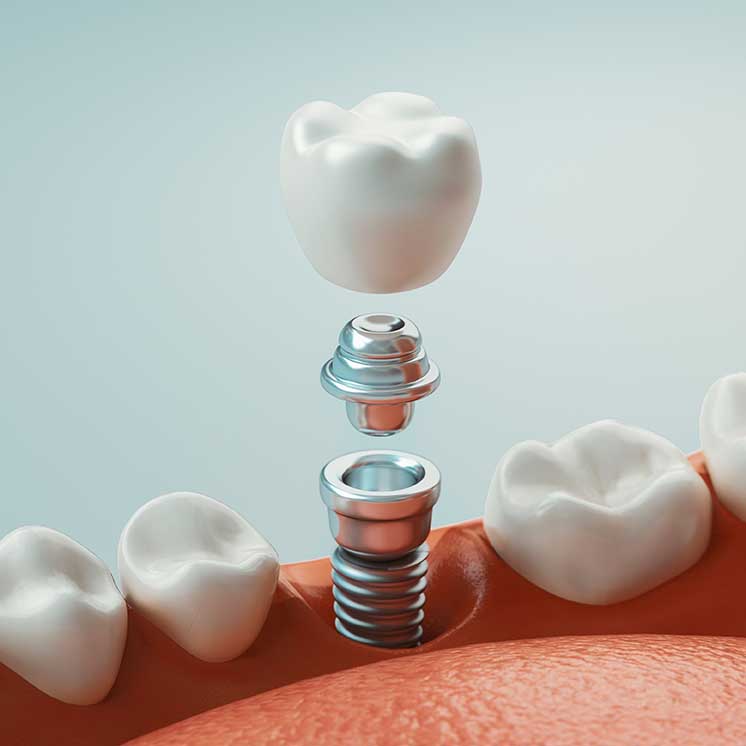
A natural tooth has two main parts: the crown you see above the gums and the root that anchors it in the jaw. A dental implant replaces the root with a small titanium post placed in the jawbone. Over a healing period, the bone fuses with the implant, creating a stable foundation. An abutment and a custom crown, bridge, or denture are then attached on top. You can learn more about single implants and our implant process on our dental implants page.
Choosing the Right Level of Tooth Replacement
Replacing a Single Tooth
A single implant with a crown replaces one missing tooth without altering the healthy teeth on either side.
Replacing Several Teeth
When a few teeth in a row are missing, two or more implants can support a bridge. This avoids the need to grind down neighboring teeth to anchor a traditional bridge.
Replacing a Full Arch
When most or all of the teeth in the upper or lower jaw are missing or failing, a full-arch restoration replaces the entire row. A small number of strategically placed implants can support a complete set of replacement teeth.
Full-Arch Treatment Options
There is no one-size-fits-all approach to full-arch replacement. During your consultation, your surgeon will explain which options are a good fit for you.
Implant-Supported Overdentures
An overdenture is a removable denture that snaps securely onto implants using ball or bar attachments. Compared to a traditional denture, it stays in place much better while you eat and talk, and you can still remove it at home for cleaning. Overdentures are a popular choice for the lower jaw, where traditional dentures are often hardest to keep in place.
Fixed Full-Arch Bridges and Same-Day Teeth
A fixed full-arch bridge is attached to implants with screws and is not removed at home. It looks, feels, and functions much like natural teeth. One well-known approach is same-day full-arch treatment, which uses four implants per arch to support a full set of teeth. In many cases, temporary teeth can be placed on the day of surgery.
Individual Implants for a Full Arch
Some patients choose individual implants to support separate crowns or shorter bridges across the arch. This approach usually requires more implants and healthy bone in several locations, so it is not right for everyone.
Comparing Your Options
| Traditional Denture | Implant-Supported Overdenture | Fixed Full-Arch Bridge | |
| Stability | Can slip while eating or speaking | Snaps securely onto implants | Fixed in place |
| Removed at home | Yes | Yes, for cleaning | No, removed only by your dental team |
| Adhesives needed | Often | No | No |
| Helps preserve jawbone | No | Yes | Yes |
| Covers the palate (upper) | Yes | Often less coverage | No |
Why Patients Choose Implants Over Traditional Dentures
When teeth are lost, the jawbone that once supported them gradually shrinks. Traditional dentures rest on top of the gums and do not stop this process. Over time, bone loss can make dentures fit poorly and can change the shape of the face. Because implants stimulate the bone much like natural tooth roots, they help preserve the jaw. Patients often notice:
- More confidence eating a wider variety of foods
- Clearer, more natural speech
- Better support for the lips and cheeks
- No denture adhesives
- Less irritation and fewer sore spots on the gums
When Bone Grafting Is Part of the Plan
If tooth loss, gum disease, or injury has reduced the bone in your jaw, you may still be a candidate for implants. Our surgeons perform bone grafting and sinus lifts to rebuild the foundation implants need. Some full-arch techniques position implants to take advantage of existing bone, which can reduce or avoid the need for grafting. We may also use platelet-rich plasma (PRP) to support healing.
Careful Planning With 3D Imaging
Successful full-arch treatment starts with a detailed plan. We use 3D imaging of your jaw to evaluate bone volume and important structures, and our surgeons use virtual surgical planning to map out implant placement before surgery. This preparation improves accuracy and helps create a smoother experience on surgery day.
Working Together With Your Dentist
Full-arch treatment is a team effort. Our surgeons place the implants and perform any extractions or grafting, while your restorative dentist designs and places your final teeth. We communicate closely throughout the process so every step stays coordinated. Dentists can send patients to us using our doctor referral forms.
What Affects the Cost of Full-Arch Dental Implants?
The cost of full-mouth dental implants depends on several factors, including:
- Whether you are treating one arch or both
- The number of implants needed
- Whether extractions or bone grafting are required
- Your choice of anesthesia
- The type of final teeth (removable overdenture or fixed bridge)
A consultation with an exam and imaging is the best way to get an accurate estimate. Our insurance and financial coordinators will help you understand your benefits, and we offer financing options through Sunbit so you can get started now and pay over time.
Frequently Asked Questions
How long do dental implants last?
Dental implants are designed to be a long-term solution. With good home care and regular dental visits, implants can last for many years. The teeth attached to them may need maintenance or replacement over time, just like any dental restoration.
Is a removable or fixed full-arch option better?
It depends on your bone, your budget, and your preferences. Removable overdentures generally require fewer implants and are easier to clean at home. Fixed bridges feel most like natural teeth. Your surgeon will walk you through the pros and cons of each.
How long does full-arch treatment take?
Treatment timelines vary. Many patients receive temporary teeth soon after implant placement, followed by a healing period of several months before the final teeth are placed. Bone grafting can add time to the process.
Am I too old for dental implants?
Age alone is rarely a barrier. Your overall health, bone quality, and ability to heal matter more than your age. We will review your medical history during your consultation.
Schedule Your Full-Arch Implant Consultation
If you are tired of missing teeth or loose dentures, our team at Oral and Maxillofacial Surgery Center of Oregon is ready to help you explore your options. Implant consultations require a referral from your dentist. Once your referral is in, call us at 541-779-7799 or complete your patient registration forms to get started.

Oral and Maxillofacial Surgery Center of Oregon
3162 State St
Medford, OR 97504
Phone: 541-779-7799
Fax: 541-779-7805
Email: frontdesk@omsoforegon.com
Business Hours:
Monday – Thursday: 7:30 AM to 4:30 PM
Friday: 7:30 AM to 2:00 PM
Areas We Serve
Rogue Valley
Medford
Grants Pass
Ashland
Klamath Falls